by
Sarah Glaz
Abstract
This article describes an innovative course developed at The University of Connecticut (UConn), whose purpose is to provide an engaging and effective preparation for science courses for students whose high school algebra needs reinforcement. The course combines a college oriented review of Intermediate Algebra with weekly group projects in mathematical modeling, and uses online resources to enhance teaching and to facilitate the coordination of the course across UConn's six campuses. The author shares the results of her two years involvement in the development of this course, as a way of offering suggestions and soliciting feedback from colleagues at other universities who face similar issues.
Technologies
Free Adobe Acrobat Reader for viewing pdf files
Publication Data
Submission Date: July 2006
Publication Date:
Copyright © 2006 by Sarah Glaz
1. Introduction
2. A College Oriented Approach to Course Material
Linked Pages:
2a. Roots and Factorization of Trinomials (pdf)
2b. Quadratic Formula Rap (pdf)
3. Off-line and Online Handouts
Linked Pages:
3a. The Paomennehal Pweor of the Hmuan Mnid (pdf)
4. Math Links For Information and Fun
5. Group Work for Collegiality and Active Learning
Linked Pages:
5a. Team Performance Agreement (pdf)
6. Mathematical Modeling Group Projects
Linked Pages:
6a. How Many Bees in Lilavati's Swarm? (pdf)
6b. Hurricane Season (pdf)
6c. Hurricane Tracking Chart (pdf)
6d. The Largest Box (pdf)
6e. Math Rocks! (jpg)
7. Feedback and Coordination Across Campuses
8. Acknowledgments
9. References and Sources
Back to Top
In Spring 2004, my Department Head had asked me if I am willing to "do something about Math 101". I have had a certain degree of success teaching and developing elementary level mathematics courses for students who are not mathematically inclined, and his request was an interesting challenge. Math 101, our remedial mathematics course, was intended for students whose high school algebra background was not sufficient for tackling the Q (quantitative) course requirements for graduation in their major. Math 101 did not carry graduation credits, and was plagued by the usual woes of being a course students suffered through along with their teachers. In addition, our advisory system has changed from mandatory placement following a Q Readiness Test, to advisory placement with no Q testing, and the number of students who should have taken a remedial mathematics course but did not, had risen dramatically.
In Fall semester 2004, I taught Math 101 for the first time, circulated a Student Questionnaire among students in lower division mathematics courses to gauge their mathematical background, and talked with colleagues from other departments about their students' mathematical needs in lower division courses. The Student Questionnaire revealed that most students entering UConn have had some form of Intermediate Algebra, or Algebra II. A closer scrutiny revealed that the content of a course did not always match its title, and in some high schools Algebra II covers just slightly more than Beginning Algebra material. In addition, even in high schools with a good reputation, Algebra II did not always treat the topics of exponential and logarithmic functions, and if treated, they were done hastily, in June, just before school ended. One thing emerged in the first conversation I had with a colleague from the Chemistry Department, their students need to know logarithms. The Mathematics and Physics Departments offer several elementary mathematical modeling courses which use exponential functions. We taught neither logarithms nor exponential functions in Math 101, and an online search for syllabi of similar courses at other universities showed that this is, unfortunately, a fairly common practice. The Statistics Department had an interest in students with more experience in solving "word" problems from other disciplines. Moreover, teaching Math 101 for the first time convinced me that repeating the material students have seen, but have not absorbed, in the same way that they were taught before, leads to nothing but boredom and frustration. My conclusion, after that semester, was that Math 101 needs to be redesigned from scratch for both content and pedagogy.
 Cover all the topics
from Intermediate and College Algebra needed for lower
division Q (quantitative) courses, including both traditional
Intermediate Algebra topics, and logarithmic and exponential
functions.
Cover all topics with
a college oriented approach. That means that topics from
Intermediate Algebra have to be approached with an emphasis on the
elements that are necessary for more advanced mathematics courses and
for courses from other disciplines.
Engage students in
elementary mathematical modeling projects on a regular (weekly) basis
throughout the semester, as a way of training them to solve multi-step
problems from other disciplines, a necessary skill for their next
course employing mathematics.
Ensure, through appropriate
teaching techniques, that the level of difficulty of this course is not
greater than the level of difficulty of Math 101; and engage students
with
the material and the course in ways that help
alleviate math anxiety, build confidence in their ability to work with
mathematical concepts, and (dare I say it) start liking mathematics.
Cover all the topics
from Intermediate and College Algebra needed for lower
division Q (quantitative) courses, including both traditional
Intermediate Algebra topics, and logarithmic and exponential
functions.
Cover all topics with
a college oriented approach. That means that topics from
Intermediate Algebra have to be approached with an emphasis on the
elements that are necessary for more advanced mathematics courses and
for courses from other disciplines.
Engage students in
elementary mathematical modeling projects on a regular (weekly) basis
throughout the semester, as a way of training them to solve multi-step
problems from other disciplines, a necessary skill for their next
course employing mathematics.
Ensure, through appropriate
teaching techniques, that the level of difficulty of this course is not
greater than the level of difficulty of Math 101; and engage students
with
the material and the course in ways that help
alleviate math anxiety, build confidence in their ability to work with
mathematical concepts, and (dare I say it) start liking mathematics. To cover the additional material and mathematical modeling projects, the course meets for longer hours than a traditional course at this level. Precisely, the course meets three times a week for a time equivalent of a 5 credit course, that is 250 minutes a week. The course contains, in addition to the review material, sufficient college material to warrant some graduation credits. Students who successfully complete the course earn 3 credits that count toward graduation. This offsets the inconvenience of longer meeting times, and is an additional incentive for students who need to reinforce their high school algebra, to actually enroll in the course.
I have taught an experimental version of the course during Fall and Spring semesters of academic year 2005/2006. In Fall semester 2006 the course becomes a permanent part of the mathematics department's curriculum, under the title: Math 104Q: Introductory college Algebra and Mathematical Modeling [4]. It will be offered simultaneously on five of UConn's six campuses, and coordinated electronically and online. In what follows, I share the results of my two years involvement in the development of this course, as a way of offering suggestions and soliciting feedback from colleagues at other universities who face similar issues.
Back to Table of Contents
After an extensive search, I adopted a book which is compatible with my aims for the course: Intermediate Algebra, by K. Elayn Martin-Gay [11]. This book is both pedagogically sound, and charmingly written. Moreover, the Instructor's Resource Manual with Tests [12] associated with the book provides a large number of imaginative practice and test exercises, and a small, but attractive, collection of group projects. More group projects were developed by me specifically for this course. The course covers 2 to 4 sections of material, and one mathematical modeling group project every week.
I now invite you to visit the course's web site of Math 104Q: Introductory College Algebra and Mathematical Modeling [4], and scroll down to the Syllabus table. The topics, for most part, are traditional Intermediate Algebra material, including: linear equations, lines, systems of equations, polynomials, rational and radical expressions. As mentioned in the Introduction, the syllabus also includes Chapter 9: Logarithmic and Exponential Functions, which is not usually part of a remedial mathematics course. Note that the semester does not end with Chapter 9, as one would expect, but rather with three possible topics from earlier chapters. This was done in response to students' comment that the material of Chapter 9 is new to them, and they need more time to absorb it before being tested on it in the Final Exam.
The Intermediate Algebra topics are covered using a College Algebra approach. I will illustrate this point with two, out of the many possible, examples:.
First
example: Throughout the
semester there is an emphasis, at all
times, on the notion of a
function, rather than on that of an algebraic expression. This includes
making sure students become familiar and are comfortable working with
function
notation, domain,
range, graphs (by hand), and interpretation of graphs. The last
is particularly important for science courses, where the formula
itself is secondary to the graph, when interpreting behavior of
phenomena. This emphasis will be further elaborated when we discuss the
mathematical modeling group projects. Second
example:
Emphasis on a more mature, college
oriented approach, to the topic of factorization of trinomials.
All Intermediate Algebra books I have looked at, approach
factorization of trinomials via the shortcut possible only when
the roots are integers. It often stays at this stage, and students
arrive to a Pre Calculus course without realizing the relation between
the roots of a polynomial and its factorization, and occasionally,
without even knowing the formula for roots of a quadratic equation. As
an
illustration of how this material may be taught with a more
mathematically mature approach, without making it more difficult
for the students, click on: Roots and
Factorization of Trinomials (this handout can also be downloaded
from the course's web page by clicking on the Pink Panther folder:
Student's Handouts). This
handout contains a
summary of lessons in factorization of trinomials using the
quadratic
formula for roots. To fill in the details for complete lesson plans,
one needs to add blackboard examples, student class work on
examples where the Instructor
circulates and makes individual comments, and one good group project
that trains and reinforces students' factoring ability. Consider making
the formula for roots of
quadratics memorable to your
students by introducing them to the Quadratic
Formula Rap . This rhyme originally
appeared in the 1885 Proceedings
of the Edinburgh Mathematical Society (unknown author) [21], and was suggested as rap lyrics by
Lawrence Lesser [10]. I will end this section by mentioning my approach to the controversial issue: Should one or shouldn't one allow use of calculators? On one hand, we want students to develop a "number sense", and correct bad habits in simple arithmetic, which can have consequences on their later use of mathematics. This can only be done by practicing arithmetic without using a calculator. On the other hand, "real life" mathematics-- the reason we want everyone to be mathematically literate, seldom deals with "nice" numbers, and a calculator is necessary in order to avoid interminable, routine calculations. To accomplish both aims, I do not allow the use of calculators on exams and on individual homework exercises, but ask students to own and use a scientific calculator for the mathematical modeling group projects.
Back to Table of Contents
The third link on the top right-hand corner of the course's web page Math 104Q: Introductory College Algebra and Mathematical Modeling [4] is a Pink Panther folder titled Student's Handouts. It contains nine handouts summarizing the knowledge students are supposed to acquire during the semester. The handout: Conversion Rectangle Trick reviews material from Algebra I, while the other eight handouts cover the material of the course one chapter at a time. I distribute these handouts in class as we reach the appropriate material in the syllabus, and encourage their use during individual and group homework assignments. To emphasize their importance, I single out these particular handouts by xeroxing them on paper of various colors. The Pink Panther folder is there for easy access in the future when the students are enrolled in their next science course.
Distributing handouts in class at appropriate times accomplishes several things:
Handing each
student every handout individually, as a gift, is one way of showing my
students I care, and establishing a relationship in which students feel
comfortable asking questions and a warm classroom atmosphere conducive
to learning.
The summary of material
for each topic, teaches by example, a correct approach to the
material for effective leaning. That is, it shows students that one
should study carefully the multitude ofinformation received on each topic, and then recognize and summarize what is important and merits additional attention.
A
short, one page,
summary of
each topic, lists concisely and
precisely what students need to absorb on each topic. These concrete
summaries present each topic as a finite, small, number of concepts,
rather than as a potentially limitless and
nebulous amount of information. This takes
the edge off the math anxiety associated with the perceived vastness of
mathematical knowledge, and makes students more comfortable with the
material and more
confident in using it. In addition to the handouts in the Pink Panther folder, I distribute other handouts during the semester. These include: course information, solutions to particular homework assignments and exams, coverage and suggested practice exercises for exams, and various humorous handouts designed to relieve tedium, increase comfort, or boost students' confidence in their ability to work with mathematical concepts. Consider making your students aware of the phenomenal power of their minds by sharing with them a handout that was given to me by one of my students: The Paomennehal Pweor of the Hmuan Mnid.
Back to Table of Contents
In the second week of the semester I take the class for a visit to the Mathematics Department's Computer Lab. This one-time visit has two purposes: providing information, and generating enchantment. Both information and enchantment can be found on the course's web page Math 104Q: Introductory College Algebra and Mathematical Modeling [4].
The information is derived by accessing the course's web page, where
students can
find general information about the course, exam dates, syllabus, office
hours, information about online and on-campus tutoring, and more. Note
that precise information on homework assignments is not included on the
course's web page. Appropriate use of web pages can provide a
wonderful opportunity for enhancing students' learning experience, but
it is not an adequate replacement for classroom instruction. To
encourage class attendance, a very important component for successful
completion of
this course, I never include on the course's web page all the
information students receive in class.
The enchantment is provided through a collection of math links: Math Links
for Information and Fun [5]. This
collection can also be reached from a
number of other places on the Mathematics Department's web pages,
including
the second link on the top
right-hand corner of the course's web page. I invite you to browse
through this collection, and become enchanted again with the way
mathematics connects to every field of human interest. Favorites
among the students are the links connecting art and
mathematics, and the geometry links scattered through several
categories. The first link on the top right-hand corner of the course's web page is in a category of its own. It is a very informative and well written article on Coping With Math Anxiety [14] from the Platonic Realms web site. I recommend that anyone suffering from Math Anxiety or teaching students who suffer from it, read this article.
Back to Table of Contents
One of the most effective strategies for teaching mathematics to students who are not mathematically inclined is the technique called cooperative learning (or group work). Cooperative learning is a teaching strategy in which the class is split into small groups. Each group works as a team on a mathematical project, with minimal interference from the Instructor. This technique has the power to engage the students with the material in ways that no other method of teaching does. Other benefits include: students learn to work as part of a team and use their peers as resources, they learn how to communicate mathematics, they are actively involved in the teaching and learning processes which enhances both their ability to do mathematics, and their confidence in this ability. In addition, the teacher benefits from having a more engaged, interested and energetic class, less absenteeism, an opportunity to observe how their students approach problems, and less homework to grade--- each group submits only one report per project. There are a number of written and online sources discussing the theoretical foundations of cooperative learning, and guiding teachers who wish to introduce this technique in their classes. A few written examples are: A Practical Guide to Cooperative Learning in Collegiate Mathematics [8], Reading in Cooperative Learning for Undergraduate Mathematics [2], and Cooperative Learning in Undergraduate Mathematics [16]. Online sources can be easily found through a Google [7] search. But, ultimately, the place where a teacher truly learns how to use the technique is in his or her own classes, where by trial and error, one can modify the basic principles to suit the personality of the teacher and the mathematical level of the students.
Cooperative learning plays an important role in the pedagogy of this course. The technique is employed in ways that alleviates students' math anxiety, increases the comfort level of interaction among students and between students and teacher, and maximizes students' engagement with mathematics. Here are a few general suggestions for introducing cooperative learning in a course of such mathematical level:
Start friendly:
To get started give the class an opportunity to form their own groups
by asking students to pair up for
group work with a friend or with the person sitting next to them. This
results in small, two
people, groups for the first and second group projects.
Occasionally larger groups get
formed this way. Monitor that the initial groups have no
more then four students each, the optimal group size. The first
assignment should
give them time in class to get started on the group work, and make sure
they need to be in touch after class to complete the assignment. After
the second group activity, ask each member of the group to submit to
you in writing how well their group functioned, and if they wish to
remain
with the same group members. Next class period assign formal groups of
three
or four students each, taking their opinion into account. Minimize
potential conflicts with a Team Performance Agreement (TPA):
Once you
assign official groups, give class
time for the groups to discuss and prepare a Team
Performance Agreement (TPA).
Click on Team
Performance Agreement
to open a handout designed to guide
the groups through the discussion of issues necessary for TPA
preparation. The idea for a TPA originated in Thomas
DeFranco and Charles Vinsonhaler's book: PProblem
SSSolving [1]. The TPA page provided in this section is a
modified version of theirs. Request that each group submits to you a
typed "legal" Team Performance Agreement (TPA), signed by all
its members. Monitor
group interactions: During group activities circulate, peek over
their shoulders, eavesdrop on
their
conversations, and smile encouragingly. Tell them to call you if they
need a little help to get started or to get unstuck. If many groups are
slow to get started on an activity, or get stuck in
the same place, ask them all to stop work for a minute and give a hint
to the entire class to help them get going. It should be a little noisy
in class during group activity. That
means they are talking with each other, which is what you want. Listen
to the noise they make. If you hear a hum like a hive of busy bees, it
means all goes well. If
it is very quiet in the room, this is not a good sign. Encourage
interaction, even if it means asking them to share with each other what
exactly they do not
understand in the problem. It is a way of getting each of them engaged
with the problem, which will eventually lead them towards a solution. Grade for collegiality:
Give a grade on the group report submitted. Every member of the group
receives the same grade. This encourages collegiality, not
competitiveness. Optimize group work
timing: I favor 15 to 30 minutes group work time at the end of a
class period. This requires a single
transition from one type of
learning activity (lecture) to another (group work), rather then two or
more
transitions. In general, it is advisable to avoid the transition from
group work to lecture
during a class
period, as students find it difficult to become relatively passive
listeners after being actively engaged in group work. Assign sufficient
class time for students to get a good head start on the group project.
The intention is to have groups finish the assignment as homework.
Still, if the group work occurs at the
end of a class period, it provides you with a natural alternative
activity for
groups who finish the project early. Have them start
cooperatively on their regular homework assignment. This encourages out
of classroom cooperation on all homework assignments, and, by
extension, for exam
preparation. Both activities are extremely beneficial for strong and
weak students alike. I will elaborate further, on the cooperative leaning aspect of this course, in the next section, where I give specific examples of group projects.
Back to Table of Contents
The syllabus table on the course's web page Math 104Q: Introductory College Algebra and Mathematical Modeling [4], lists a selection of group projects following each chapter. Some of these projects are taken from the Instructor Manual that comes with the textbook, and other are original group projects I developed specifically for this course. Students engage in one group project every week. This means that the class works on a total of 14 group projects during the semester, one or two for each chapter on the syllabus. All group projects have some relation to mathematical modeling. At least one group project for every chapter is a mathematical modeling project with real data. The rest are group projects designed to fulfill a variety of other pedagogical needs, including reinforcement of mathematical techniques such as factoring polynomials, or the rules of exponential and logarithmic functions. In addition to the benefits outlined in the previous section, working on these group projects, makes students aware of the place of mathematical concepts in a broad cultural setting. This often results in an appreciation of, previously disliked, abstract mathematical notions, and a new motivation to master them.
The three group projects discussed below give a flavor of the nature of the group project I developed for this course.
Algebraic Poetry:
Click on How Many
Bees in Lilavati's Swarm? to open a handout of a group
project on solving linear equations (with solution). This project falls
into the category of uses of history in the teaching of mathematics. Bhaskara [18]
was a twelve century Indian mathematician who authored the book Lilavati,
written in verse, for the mathematical education of his daughter. The
citation comparing Bhaskara to "the crest on a peacock" comes
from [9], and the translation of this
charming poem comes from [17]. As a
group project , it seemed particularly appropriate to introduce it
just after finishing the "word problem" section, as a replacement for a
number
of more conventional homework exercises. It reinforces the four
customary steps students are advised to follow to understand and solve
"word problems". The naming of these steps: Understand, Translate,
Solve, and
Interpret is K. Elayn Martin-Gay's [11].
This choice of words brings home the fact that mathematical modeling is
just "a translation" of real-life phenomena into mathematical language,
and that after obtaining the mathematical solution, one needs to
interpret the solution into the real-life language of the original
problem. The Trial
and Error technique advocated in the Understand step,
is my suggestion. It develops students' number intuition, and their
grasp of the trial and error aspect of the mathematical modeling
process. It also bridges the gap between the concreteness of the
numerical
solution, and the abstractness of the equation. Finally, students are
delighted to explore a connection between the language of poetry, which
many of them love, and the language of mathematics. They even forgive
me and Bhaskara, for introducing so many "hateful" fractions into the
equation.Other poems from Lilavati appear on various web sites, and can be used as basis for additional group projects. Here is one, Mathematical Problem [20], which is not quite appropriate for that purpose.
There are more modern sources of algebraic poems, for example How Old Is the Rose-Red City? [19] by Martin Gardner. For the written source, complete with the story connected to this rhyme, see [3].
Forces of Nature:
Click on Hurricane
Season,
and Hurricane
Tracking Chart,
to open the handouts that make up a group project on the coordinate
system and lines (with solution).
This is a group project in environmental mathematical modeling using
real data. Students are asked to play the role of meteorologists
working at
the National
Hurricane Center (NHC) [13] in Miami,
Florida, and are engaged in
hurricane tracking and modeling of hurricane damages. The NHC site is
the source of all the data for this group project, and the enclosed Saffir-Simpson
Hurricane Scale, and Hurricane Tracking Chart.
The Hurricane
Tracking Chart is used by the students to track the 1992
hurricane Andrew, which was one of the most ferocious hurricanes in US
history. I developed this group project the year before hurricane
Katrina hit US, but in any event, even today, it is not possible to
prepare a
group
project on hurricane Katrina, since not all relevant data is yet in.
This
is a good group project to introduce following the chapter on the
coordinate system and lines during a Fall semester. In the Fall
semester the class reaches that point in the curriculum during
the hurricane season, and this project generates considerable
excitement. Employing role playing is designed to further engage the
students with the drama of hurricane tracking. Hurricane tracking
essentially employs coordinate system plotting, and makes this
activity, and its related issues of coordinate scaling, very natural
and manageable. Further graphing of the Wind Speed Curve
gets students used to interpreting graphs, and the predictions
regarding Andrew's strength on its second landing, and the magnitude of
Andrew's damages, show them the limits of our ability to model and
predict nature. The second part of the project, assessing hurricane
damages employing a linear model, is designed to illustrate the natural
meaning of slope, y-intercept, and graph of a line. According to NHC,
the relation between hurricane wind speed and damages is not linear,
but exponential. This may be used to prepare a continuation of this
group project to be introduced after the sections on exponential
functions. But, by the time the class reaches that point in the
syllabus, hurricane season is over, and I opt for a group
project on modeling the growth of the black bear population, which is
on the rise in Connecticut. The possibilities for developing environmental mathematical modeling group projects using real data are endless. All phenomena in which forces of nature show their strength involve quantitative aspects. Much of the data can be easily found online, and the mathematics involved ranges from the most basic to the most sophisticated. Another source of environmental mathematical modeling consists in the various damages human beings inflict on the environment. Those vary from water and air pollution, to accidents involving hazardous materials, to nuclear disasters and global warming. The reader can find links to various environmental sites that can serve as sources of data and inspiration for group projects, by checking the links page on Math 108QC: Mathematical Modeling in the Environment [6], a course I have developed a few years ago.
Hands-on Group Projects:
Click
on The Largest Box
to open a handout of a group project on polynomials (with
solution). This project is a modification of an exercise that
is appearing for years in various Calculus, Pre Calculus and College
Algebra books. The purpose of the original exercise is to find the
maximum of a function using either the derivative or a calculator-drawn
graph. In The
Largest Box the exercise is converted into a
mathematical modeling project at Intermediate Algebra level, which,
without mentioning more advanced mathematical concepts, prepares
students for these concepts. I introduce the project in the middle of
the
chapter on polynomials, after an interval of time in which
the notion of a function is not in use. The Largest Box,
in
addition to practicing basic polynomial manipulations, reintroduces and
reinforces the notion of a function, including domain and
range calculations and visualization. But, the real impact
of this project
comes from its hands-on approach, which transform abstract
mathematical notions into concrete and familiar entities. Each
group is given the cardboard backing of a notepad and asked to
construct an actual box. The box has its practical uses, and also
provides an opportunity to discuss in class some mathematical and
ethical aspects of modeling container boxes for cereal
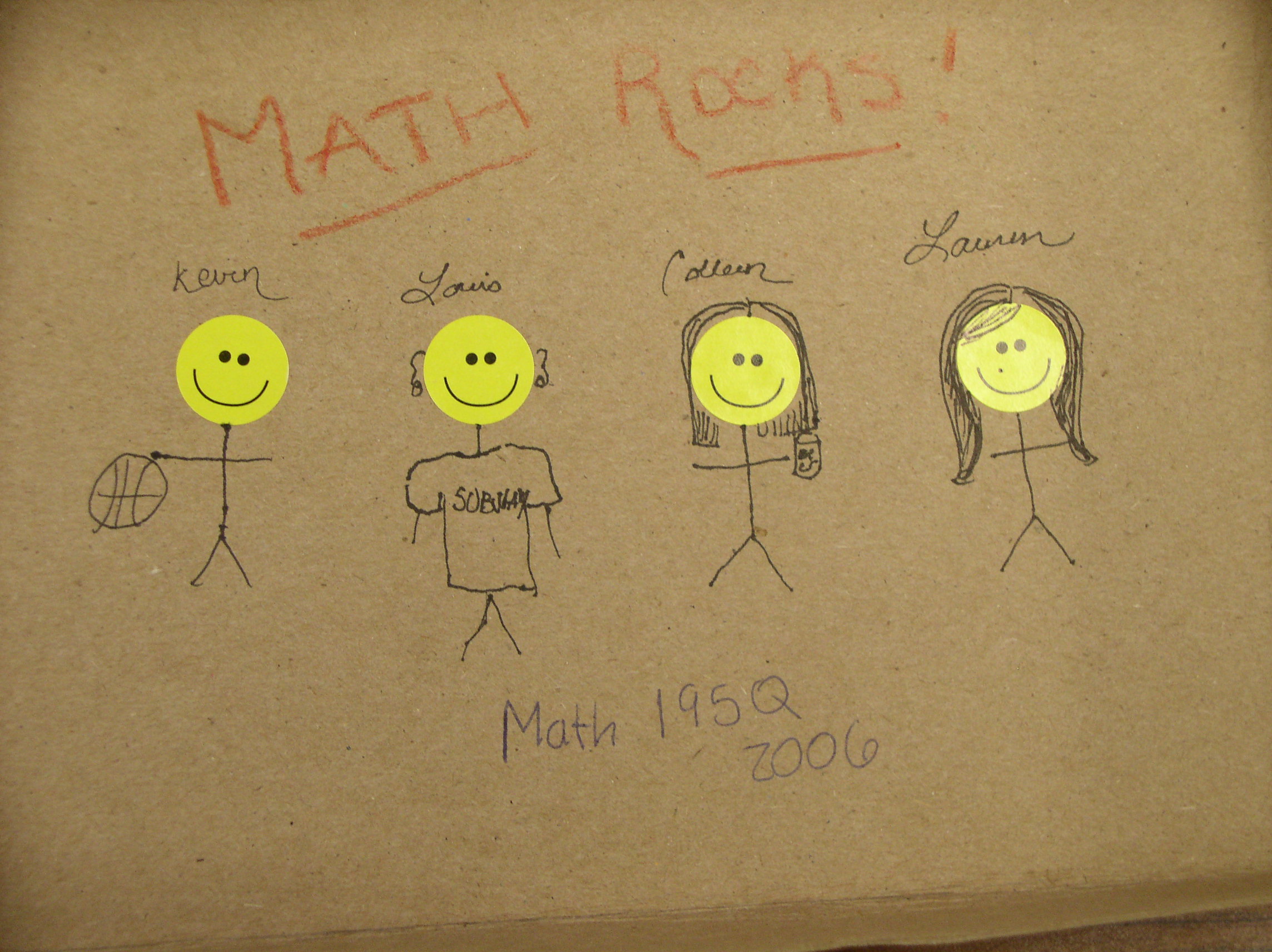
manufacturers. Students' reaction to this group project made it very
special to
me. In students' own words: Math Rocks!
Clicking on this link opens a photograph of
the box constructed by one of
the groups in my Spring 2006 experimental class (whose number was Math
195Q). It is difficult to come up with hands-on mathematical modeling group projects, at this mathematical level. Another type of hands-on group projects consists of certain puzzles involving cut outs. These can be useful as entertaining group activities for reinforcing mathematical techniques. An interesting example is the Logarithmic Equations Cut-outs [15] on The Handley Math Page of David Pleacher.
Back to Table of Contents
This course is meant to effect a complete change in the way remedial mathematics is delivered at the University of Connecticut. As such, the course affects many people, across all six campuses of the university, including: students, Instructors, Student Advisors, and administrators. In order to ensure that the resulting course responds to the needs of all those affected by it, it was important to get feedback on the contemplated changes, throughout the entire period of the course's development. I set up a feedback system, which evolved along with the course, and eventually became the system through which the course is and will continue to be coordinated across all university's campuses.
Face to face feedback was provided by the students in my classes. Students were consulted on every aspect of the course including: group projects, choice of textbook, calculator policy, order of topics in the syllabus, length of class periods, pace of teaching, test related issues, and much more. I let the students know, at the beginning of each semester, that they are participating in an experimental class designed to improve the delivery of the preparation for sciences course at UConn, and that their input will affect the way the course will be delivered in the future. I solicited feedback frequently and informally from the entire class and from individual students. In addition, many students gave me feedback on selected items on their own initiative. Their contributions, and their enthusiastic response to my request for input, shaped the final version of this course in ways I have not always anticipated.
I have also received substantial feedback from the graduate student TAs who taught sections of Math 101 during the period of this course's development. I met with the TAs once a week, to provide guidance and receive feedback. They provided input on several of the group projects, which I e-mailed them in advance, both before and after they tried them in their classes. They also helped me develop a write up for guiding Instructors through the introduction of cooperative learning in their classes (which is currently placed on the course's web page in the Instructor's Resources folder), and contributed to the fine tuning of other classroom experiments. I found the weekly, guidance and feedback, meetings to be a very satisfactory and effective way of coordinating the delivery of a course by TAs, and plan to continue this practice.
In order to communicate with colleagues I could not easily meet in person, I set up an e-mail list consisting of all instructors of Math 101 across university's six campuses, and other colleagues and Student Advisors who wished to be updated on the changes as they occur. This e-mail list turned out to be an efficient and pleasant way to keep in touch with colleagues with an interest in the new course, and to provide and receive useful information affecting its teaching. With an appropriate name change, I plan to continue using the e-mail list for exchanging information, and for coordinating the teaching of the course across all campuses.
A growing amount of material relevant to the teaching of this course was accumulating in my computer folder. To make this material easily available on all university's campuses, I placed it in a password protected file on the course's web page Math 104Q: Introductory College Algebra and Mathematical Modeling [4] , the link on the top left-hand corner: a Teacher folder titled Instructor's Resources. All Instructors teaching this course have access to the password. Readers of the present article have had a sample from most sections of the Instructor's Resources folder. For pedagogical and copyright reasons, this folder cannot be made accessible to students, or to the general public.
Fall 2006, is the first time that the course will be offered as a permanent part of the Mathematics Department's curriculum. At present, enrollments on all campuses seem healthy, and if students' response to the experimental versions is any indication, students will enjoy the course, and end up being better prepared for their next science course, as a result of enrolling in it.
Back to Table of Contents
I am grateful to the University of Connecticut for awarding me a 2005 Provost's General Education Course Development Grant, which made the development of this course and the writing of this article possible. I also wish to thank for help and support many students and colleagues at the University of Connecticut without whom this project would not have gotten off the ground: my Department Head, Michael Neumann, for asking me to take this project on, and for his continuos support; all my colleagues in the Mathematics Department Undergraduate Program Committee, and the Math 101 e-mail list, especially David Gross, Judy Lewis, Gery Liebowitz, and Jeff Tollefson, for advise, input and encouragement; Associate Provost, Steven Jarvi, his team of Student Advisors, as well as other Student Advisors across the University, for the many ways in which they encouraged the development of this course; graduate students, Luke Hodges and Stephanie Hartman, who tried many of the group projects in their sections of Math 101, and whose input improved the group projects and many other pedagogical aspects of the course; my colleagues, Tom DeFranco and Charles Vinsonhaler, whose book inspired me to experiment with cooperative learning; my colleagues, Jim and Cecile Hurley, who, both separately and together, provided valuable practical advise and moral support; our System Manager, Kevin Marinelli, for technical assistance and for photographing The Largest Box. Last, but not least, I wish to thank my students in Math 101 and the experimental versions of Math 104Q, without whose enthusiastic input and willingness to join me in experimentation, there would have been no such course.
Back to Table of Contents
References and
Sources
1 Thomas C.
DeFranco,
and
Charles I. Vinsonhaler, PProblem
SSSolving, 2nd Ed., Thomson
Custom
Publishing, 2004
2 Ed Dubinsky, David Mathews, Barbara E. Reynolds, Editors, Readings in Cooperative Learning for Undergraduate Mathematics, MAA, 1997
3 Martin Gardner, My Best Mathematical and Logic Puzzles, Dover, 1994
4 Sarah Glaz : Math 104Q: Introductory College Algebra and Mathematical Modeling, http://www.math.uconn.edu/~glaz/math104
5 Sarah Glaz: Undergraduate Resources: Math Links for Information and Fun, http://www.math.uconn.edu/~glaz/Fun_Math_Links/
6 Sarah Glaz: Math 108QC: Mathematical Modeling in the Environment, http://www.math.uconn.edu/~glaz/math108
7 Google: Search Engine, http://www.google.com
8 Nancy L. Hagelgans, Barbara E. Reynolds, Keith Schwingendorf, Draga Vidakovic, Ed Dubinsky, Mazen Shahin, and G. Joseph Wimbish, Jr.,
A Practical Guide to Cooperative Learning in Collegiate Mathematics, MAA, 1995
9 George Gheverghese Joseph, The Crest of the Peacock, The Non European Roots of Mathematics, Princeton University Press, 2000
10 Lawrence Mark Lesser, Sum of Songs: Making Mathematics Less Monotone, The Mathematics Teacher, Vol. 93, 372-377, 2000
2 Ed Dubinsky, David Mathews, Barbara E. Reynolds, Editors, Readings in Cooperative Learning for Undergraduate Mathematics, MAA, 1997
3 Martin Gardner, My Best Mathematical and Logic Puzzles, Dover, 1994
4 Sarah Glaz : Math 104Q: Introductory College Algebra and Mathematical Modeling, http://www.math.uconn.edu/~glaz/math104
5 Sarah Glaz: Undergraduate Resources: Math Links for Information and Fun, http://www.math.uconn.edu/~glaz/Fun_Math_Links/
6 Sarah Glaz: Math 108QC: Mathematical Modeling in the Environment, http://www.math.uconn.edu/~glaz/math108
7 Google: Search Engine, http://www.google.com
8 Nancy L. Hagelgans, Barbara E. Reynolds, Keith Schwingendorf, Draga Vidakovic, Ed Dubinsky, Mazen Shahin, and G. Joseph Wimbish, Jr.,
A Practical Guide to Cooperative Learning in Collegiate Mathematics, MAA, 1995
9 George Gheverghese Joseph, The Crest of the Peacock, The Non European Roots of Mathematics, Princeton University Press, 2000
10 Lawrence Mark Lesser, Sum of Songs: Making Mathematics Less Monotone, The Mathematics Teacher, Vol. 93, 372-377, 2000
11 K. Elayn Martin-Gay,
Intermediate
Algebra, 4th Ed., Prentice Hall, 2005
12 K. Elayn Martin-Gay, Instructor's Resource Manual with Tests for Intermediate Algebra 4th Ed., Kathryn Wetzel, Shara Wetzel, Bobby May, Prentice Hall, 2005
13 National Hurricane Center, Miami, Florida, http://www.nhc.noaa.gov
14 Platonic Realms Minitext: Coping With Math Anxiety, http://www.mathacademy.com/pr/minitext/anxiety/index.asp
15 David Pleacher: The Handley Math Page: Logarithmic Equations Cut-outs, http://www.pen.k12.va.us/Div/Winchester/jhhs/math/lessons/algebra/log.html
16 Elizabeth C. Rogers, Barbara E. Reynolds, Neil A. Davidson, and Anthony D. Thomas, Editors, Cooperative Learning in Undergraduate Mathematics, MAA, 2001
17 Malba Tahan, The Man Who Counted, Translated by Lesley Clark and Alastair Reid, W.W. Norton & Company, 1993
18 The MacTutor History of Mathematics Archive: Bhaskara's Biography, http://www-history.mcs.st-and.ac.uk/%7Ehistory/Biographies/Bhaskara_II.html
19 The Magic Dragon Ultimate Science Fiction Poetry Guide: Martin Gardner, http://www.magicdragon.com/UltimateSF/sfpo-14pt0.html#gardner
20 The Wondering Minstrels: Mathematical Problem, by Bhaskara, http://www.cs.rice.edu/~ssiyer/minstrels/poems/1313.html
21 Unknown Author, Quadratic Formula Rap, Proceedings of the Edinburgh Mathematical Society, Vol. 3, 106-107, 1885
Back to Top
Copyright © 2006 by Sarah Glaz
12 K. Elayn Martin-Gay, Instructor's Resource Manual with Tests for Intermediate Algebra 4th Ed., Kathryn Wetzel, Shara Wetzel, Bobby May, Prentice Hall, 2005
13 National Hurricane Center, Miami, Florida, http://www.nhc.noaa.gov
14 Platonic Realms Minitext: Coping With Math Anxiety, http://www.mathacademy.com/pr/minitext/anxiety/index.asp
15 David Pleacher: The Handley Math Page: Logarithmic Equations Cut-outs, http://www.pen.k12.va.us/Div/Winchester/jhhs/math/lessons/algebra/log.html
16 Elizabeth C. Rogers, Barbara E. Reynolds, Neil A. Davidson, and Anthony D. Thomas, Editors, Cooperative Learning in Undergraduate Mathematics, MAA, 2001
17 Malba Tahan, The Man Who Counted, Translated by Lesley Clark and Alastair Reid, W.W. Norton & Company, 1993
18 The MacTutor History of Mathematics Archive: Bhaskara's Biography, http://www-history.mcs.st-and.ac.uk/%7Ehistory/Biographies/Bhaskara_II.html
19 The Magic Dragon Ultimate Science Fiction Poetry Guide: Martin Gardner, http://www.magicdragon.com/UltimateSF/sfpo-14pt0.html#gardner
20 The Wondering Minstrels: Mathematical Problem, by Bhaskara, http://www.cs.rice.edu/~ssiyer/minstrels/poems/1313.html
21 Unknown Author, Quadratic Formula Rap, Proceedings of the Edinburgh Mathematical Society, Vol. 3, 106-107, 1885
Back to Top
Copyright © 2006 by Sarah Glaz