A Poem-Collage Pair
Poem by Sarah Glaz with Collage by Mark Sanders
The poem-collage pair appears in the Bridges 2026 online art gallery:
Mark Sanders, Sarah Glaz | Bridges 2026 Exhibition of Mathematical Art, Craft, and Design | Mathematical Art Galleries
 |
 |
History, Mathematics, Poem, Collage
A
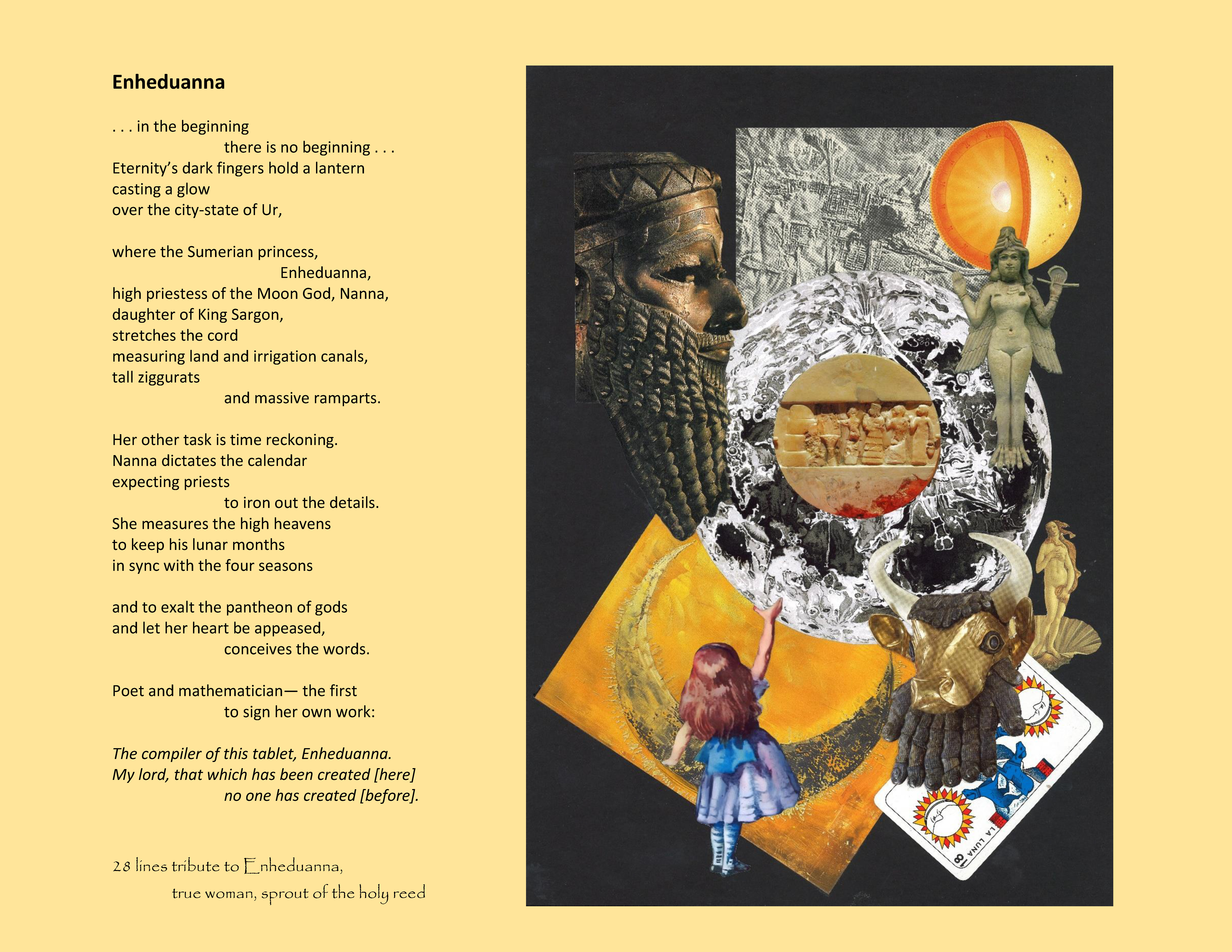
1927 archaeological excavation at the Sumerian city of Ur
uncovered a temple complex dedicated to the moon god Nanna.
Among the fascinating artifacts found at the site was a
calcite disk, dated to circa 2300 BCE, shown in the center of
the collage. The inscription on the back of the disk
identifies the central figure as Enheduanna, daughter of King
Sargon and high priestess of Nanna. This discovery
introduced the modern world to one of the most remarkable
women of deep antiquity: Enheduanna―princess, high priestess
of the moon god Nanna, poet, and perhaps also mathematician.
The
city of Ur was founded circa 4000 BCE in Mesopotamia, a region
corresponding largely to present-day Iraq. The area has been
the center of successive civilizations since the Neolithic
period. The main civilizations after the 5th
millennium BCE were in turn the Sumerian, the Akkadian, and
the Babylonian. Mesopotamia is often referred to as the
"cradle of civilization," the place where human beings took
their first steps toward a civilized society and left a
written record of their achievements. Writing, in the form of
cuneiform script, was invented by the Sumerians around 3500
BCE. In 2334 BCE, the Akkadian king Sargon, conquered the
region and ruled it until 2279 BCE. The bronze head shown at
the top left of the collage (circa 2300 BCE) is that of King
Sargon, while the carved bull's head at the bottom right is a
decorative element from a lyre discovered in the king's grave.
Enheduanna
was
appointed by her father as high priestess of the moon god,
Nanna, the patron deity of the city of Ur. She held this
prestigious position for over forty years, spanning the reigns
of several Akkadian kings. After her death, she attained
semi-divine status. Today, Enheduanna is best known for her
literary achievements. She distinguished herself as a poet,
not only by creating verses of beauty and power, but also by
departing from the customary anonymous writing tradition of
her time and explicitly identifying herself as the author of
her works.
Enheduanna
is the earliest known named author in history.
The
Old Akkadian period (circa 2350 - 2200), during which
Enheduanna lived and composed her poetry, was a time of
transition in the development of Mesopotamian mathematics. Its
beginnings lay in the almost proto-mathematical stage of
metrological numeration systems, and its ending heralded the
adoption of the sexagesimal place value number system and the
flourishing mathematics of the Babylonian period. As a result,
Enheduanna's temple hymns that touch on mathematics allow us
to hear the story of mathematics' complex beginnings in the
voice of a culture that experienced it―as much as this is
possible to do in a different language and several thousand
years removed from that time.
Among
Enheduanna's poems, Temple Hymn 42, dedicated to Nisaba―the
goddess of writing and mathematics―stands out as one
of the oldest surviving sources that reflects what mathematics
meant in that era and illuminates the role of the
mathematicians at the time. Lines twelve and thirteen of the
hymn describe
Nisaba's, and possibly also Enheduanna's, role as a
mathematician.
She
measures the heavens above
and
stretches the measuring cord on the earth.
Mesopotamian
mathematicians
were engaged both in astronomical calculations―"measuring the
heavens"―and in practical mathematical activities such as land
measurement and construction― "stretching the measuring cord
on the earth." Enheduanna's poetry offers rare insight into
the nature of these activities and their cultural
significance.
Further discussion of Mesopotamian mathematics and its
relationship to Enheduanna's temple hymns can be found in Sarah's paper: Enheduanna:
Princess,
Priestess, Poet and Mathematician, The
Mathematical Intelligencer 42 (2), 31-46, 2020.
Further details on the collage images can be found in Mark's
write-up: Dissecting
Enheduanna
A
printable version of this website: Handout for
Enheduanna